



If your teen took the PSAT this month, the next step is to look out for the score report. Some families get it within days, while others wait until mid-November. To know exactly when your student’s scores will be available, ask your school counselor or check your student’s College Board account for the latest updates. This way, you can avoid surprises and feel more prepared. Once the scores arrive, everyone is left looking at the same set of numbers, trying to decide if it’s good news.
This guide explains what’s on the score report, how the National Merit Selection Index is figured out, and what steps to take based on your student’s grade. Most people focus on the total score, but the section scores and skill breakdowns are just as important for planning study time in the coming months. Begin by figuring out which part of the report is most important for your student right now.
When do PSAT scores come out in 2026?
The College Board doesn’t release PSAT/NMSQT scores all at once. When your student gets their score depends on when the school sent in the answer files, so even students who took the test on the same day might get results at different times. In fall 2026, scores started coming out on October 22, then November 5, and November 12. Your school counselor can tell you which date applies to your student, and the scores will also show up in your student’s College Board account.
Quick note for juniors: The PSAT score released in November is not a National Merit Semifinalist notification. It is used to calculate the Selection Index that determines eligibility. High schools notify students who qualify as Semifinalists in September of their senior year. For the Class of 2028, the Semifinalist cutoff will not be known until September 2027. Until then, students can use previous cutoffs as a reference, but the next qualifying score cannot be confirmed in advance.
What is on a PSAT score report
The digital PSAT/NMSQT report gives you several numbers, and each one tells you something different.
Total score (320 to 1520). That is the figure most people quote. It is the total of the two section scores.
Section scores (160 to 760 each). One score is for Reading & Writing, and the other is for Math. Look at these before you check the total. For example, a 1300 made up of 700 in Math and 600 in Reading and Writing means something different than a 1300 with both scores equal.
Percentiles. These place your student in context with other test takers. They’re useful for context, but a percentile won’t tell you what skills to practice.
Skill-area breakdown. This section is especially helpful for planning study time. It shows how your student did in specific areas of Reading, Writing, and Math. Use this to spot strengths and weaknesses and figure out which skills need more practice.
Selection Index (juniors only). This is the number National Merit uses, and it is calculated differently than the total score.
How the National Merit Selection Index works
To calculate the Selection Index, double your student’s Reading and Writing score, add the Math score, and then divide by 10. The highest possible Selection Index is 228.
Because Reading and Writing are counted twice, two students with the same total score can have different Selection Index results. For example, here are two juniors who both scored 1420:
- Student A: 700 Reading and Writing, 720 Math. Selection Index: (1400 + 720) ÷ 10 = 212
- Student B: 720 Reading and Writing, 700 Math. Selection Index: (1440 + 700) ÷ 10 = 214
A higher Selection Index can help a student reach the Semifinalist cutoff, but a difference of just two points doesn’t guarantee a certain result. Semifinalist status depends on your state’s cutoff, while Commended recognition uses a separate national cutoff. That’s why it’s important to focus on Reading, Writing, and Math when getting ready for the PSAT.
What counts as a good PSAT score?
It depends on the grade and the goal.
Juniors aiming for National Merit should check-
If their Selection Index meets their state’s Semifinalist cutoff. Each state sets its own cutoff, which changes each year and is announced in September of senior year. For example, Texas’s cutoff for the Class of 2027 was 219. This is a helpful reference, but it’s not a guaranteed target for the Class of 2028. Texas will announce the next cutoff in September 2027. To find the latest cutoff for your state, check the official National Merit Scholarship Corporation website or ask your school counselor. If your score is below the Semifinalist cutoff, you might still qualify for Commended recognition, which uses a separate national cutoff
Freshmen and sophomores –
These grades are not part of the National Merit Score. Use the report as the baseline. A sophomore with a weak October Reading and Writing score still has time to improve before the test that matters.
For everyone, the PSAT has two main purposes-
For eligible juniors, it helps decide National Merit recognition. For all students, it’s a way to check academic progress. Look at the section scores and skill breakdowns to find strengths and areas to work on before the SAT. Remember, a PSAT score shows where you are now, not where you’ll end up.
What to do in the next two weeks
1. Compare the two section scores.
Since Reading and Writing counts double, juniors aiming for National Merit should pay extra attention to that score.
2. Pick two or three weak skill areas, not ten.
Open the skill breakdown and select the lowest-scoring areas. Work from a short list. A long list of weak areas can become overwhelming, so start with just two or three. Once you identify your target skills, turn to trusted resources. The College Board offers free practice through Official Digital SAT Prep on Khan Academy, which aligns closely with PSAT skills. For math and reading support, websites like IXL, Varsity Tutors practice tests, and Purple Math (for math explanations) are strong choices. If you prefer a more structured program, our Digital PSAT Mastery and Strategy course walks students through personalized practice with guidance from experienced tutors. Even spending 20 minutes a day on targeted practice can make a noticeable difference over time.
3. Try the problems again without notes.
Have your student work through a few new questions in each weak area. If they can solve them and explain their steps, that skill is likely solid. If they get stuck, review the main concept and try a harder problem.
4. Figure out what the next test will be.
For juniors, since you can’t retake the PSAT for National Merit, the next step is the SAT. Use the same skills to aim for strong SAT scores, and treat the SAT as another chance to show what your student knows. Our Digital SAT Preparation program continues from where the PSAT ends, and our SAT preparation guide explains how the two tests are related.
If the score is lower than you hoped
One test score from one morning doesn’t define your student. Things like test day nerves, poor sleep, or tricky questions can affect the result. Look over the section and skill results before making any judgments. Remind your child that one test doesn’t decide their future or abilities. Progress takes time, and growth matters most. If the weak spots are in algebra or problem solving,high school math tutoring can help. If they’re in grammar, reading, or writing,reading and writing support is usually best. Use the results to pick the next step for support.
Planning for the next PSAT

For sophomores, the October PSAT in junior year is the one that counts for National Merit, and there’s no second try. Start preparing in the summer before junior year, or about two to three months before the test, to give yourself enough time to build skills without feeling rushed. This is just a suggested timeline, not a rule. Start with your weakest skills and build from there.
Here is a sample weekly prep schedule for students getting ready for the PSAT:
Week 1: Look over your score report or take a diagnostic test to find your two or three weakest skill areas in Reading, Writing, or Math. Set up a quiet place to study and gather any materials you’ll need.
Weeks 2-5: Spend 20 to 30 minutes, three times a week, working on one target skill each session. Use official practice tools like Khan Academy, practice questions, and explanations to build confidence. At the end of each week, review a few new practice problems to see how you’re doing.
Weeks 6-8: Start working on timed practice sections, switching between Reading & Writing and Math. Keep working on any tough weak spots, but try to take at least one full-length digital practice test by week 8. Use your results to make any final changes to your study plan.
Final week: Taper off intense practice and focus. Final week: Ease up on intense practice and spend time reviewing key concepts and strategies. Make sure to get plenty of rest before test day and go over your plan for the morning of the exam. You can adjust the number of sessions and focus areas based on their individual schedules and needs. The most important thing is consistency and making steady progress.
Freshmen and sophomores who start early will be better prepared for the SAT later on. To learn more about our approach, visit our Digital PSAT Mastery and Strategy page. It includes a free diagnostic assessment so you can see where your student stands before making any decisions.
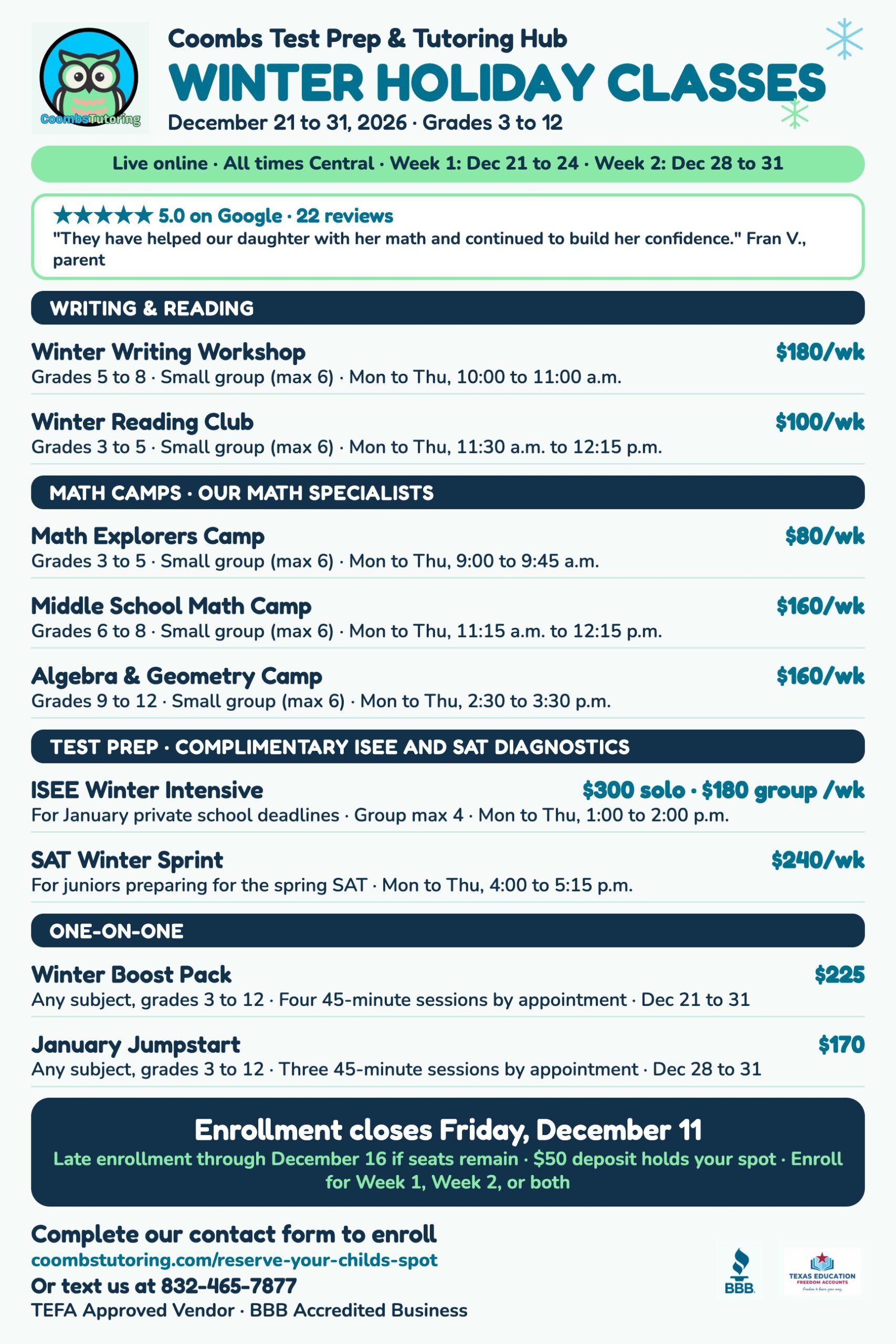
Would you like someone to review your student’s score report?
We offer a free diagnostic assessment and can review your student’s PSAT and SAT progress. You can reserve a spot, or call or text 832-465-7877. If you want more details before starting, check out our parent FAQ.