



SAT Test Preparation is most effective when students understand what the Digital SAT tests, identify the specific skills they need to improve, and follow a focused study plan instead of simply completing practice questions without a clear strategy.
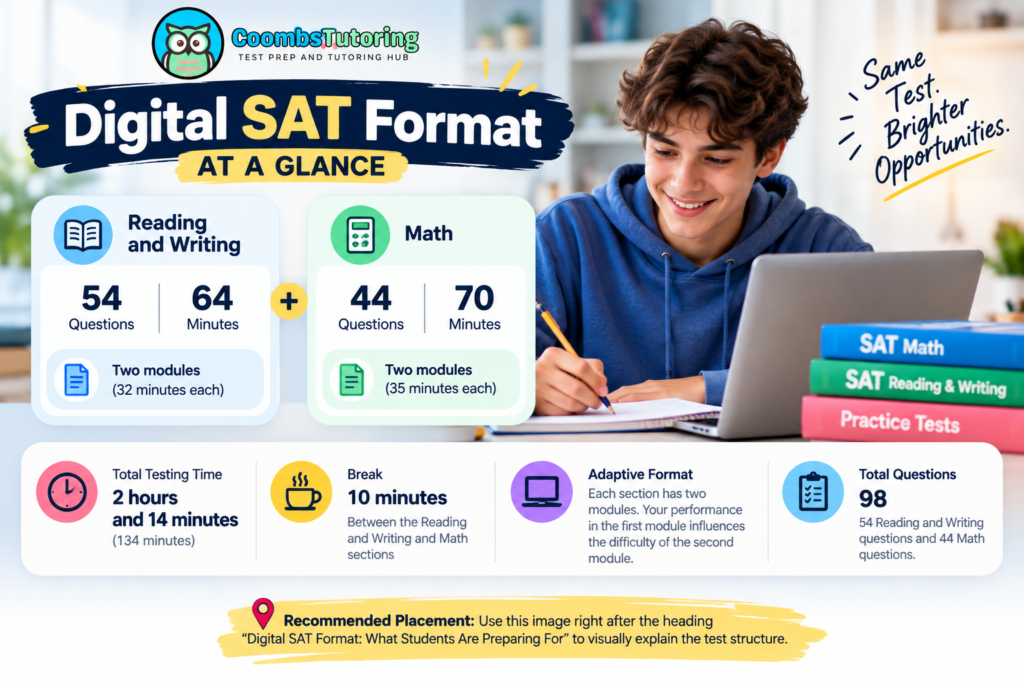
The Digital SAT measures skills across two sections: Reading and Writing and Math. According to the College Board’s official SAT structure, the test contains 98 questions and 2 hours and 14 minutes of testing time, with a 10-minute break between the Reading and Writing and Math sections.
But understanding the format is only the starting point.
Effective SAT preparation should help a student answer four important questions:
Where am I now?
Which skills need the most attention?
What should I practice next?
Is my preparation actually improving those skills?
At Coombs Test Prep & Tutoring Hub, students can receive online academic tutoring and Digital SAT preparation from educators with subject-specific experience. Coombs provides online tutoring for students in grades 3–12 and serves families in Texas and nationwide.
This guide explains how students can approach SAT Test Preparation more strategically, use official SAT practice resources, strengthen Math and Reading and Writing skills, learn from mistakes, create a realistic study routine, and determine when personalized academic support may be useful.
Digital SAT Format: What Students Are Preparing For
Before creating a study plan, students should understand the current Digital SAT format.
According to the College Board SAT Structure Guide, the exam is organized as follows:
| Digital SAT Section | Questions | Time |
| Reading and Writing | 54 | 64 minutes |
| Math | 44 | 70 minutes |
| Total | 98 | 134 minutes |
Reading and Writing consists of two 32-minute modules.
Math consists of two 35-minute modules.
Students receive a 10-minute break between the Reading and Writing and Math sections.
How does the adaptive Digital SAT work?
The Digital SAT uses a multistage adaptive format.
Both Reading, Writing and Math are divided into two modules. The first module contains questions across a range of difficulty levels. A student’s performance in the first module influences whether the second module is relatively more or less difficult.
This has an important implication for SAT Test Preparation:
Students need transferable skills, not memorized answers.
A student should be able to recognize and apply a mathematical concept, grammar rule, or reading strategy even when a question looks different from examples they have previously completed.
Start With an SAT Baseline
Before deciding what to study, determine what the student already understands.
One of the most useful starting points is an official full-length practice test.
Students can take official Digital SAT practice tests through Bluebook.
A baseline practice test can help identify:
- stronger and weaker sections;
- specific skills requiring additional attention;
- recurring mistakes;
- pacing difficulties;
- concepts the student already understands;
- areas where knowledge exists but application is inconsistent.
Don’t focus only on the total score
Imagine two students receiving similar Math scores.
One repeatedly misses algebra questions because the underlying concepts are unclear.
The other understands the algebra but loses points because questions are being rushed or important details are being overlooked.
The scores may look similar.
The preparation plans should not.
This is why students and parents should look beyond the overall practice score and identify why individual questions are being missed.
Turn Practice Test Results Into a Study Plan
After completing a practice test, students can classify mistakes according to their underlying cause.
Concept Gap
The student does not fully understand the mathematical concept, grammar rule, or reading skill being tested.
What to do: Review the underlying concept before attempting additional questions on that skill.
Reasoning Error
The student understands the concept but applies it incorrectly.
What to do: Compare the student’s reasoning with the correct approach and identify where the reasoning changed direction.
Reading Error
The student overlooks or misinterprets information in the question or passage.
What to do: Practice identifying exactly what information is provided and what the question is asking.
Execution Error
The student understands the method but makes a calculation, notation, grammar, or answer-selection mistake.
What to do: Develop a short checking process before finalizing an answer.
Pacing Issue
The student can answer the question correctly but spends too much time doing so.
What to do: Build accuracy first and then gradually introduce timed practice.
This turns:
“I got this question wrong.”
into:
“I understand why I got this question wrong and what I need to practice next.”
That is a much more useful outcome from practice.
Create an SAT Error Log
An error log is a simple way to make SAT practice more purposeful.
It does not need to be complicated.
| Skill | Why I Missed It | What I Need to Review | Retested? |
| Linear equations | Concept gap | Solving equations | Yes/No |
| Transitions | Misread relationship | Transition functions | Yes/No |
| Reading evidence | Unsupported assumption | Evidence from the text | Yes/No |
| Word problem | Misread condition | Translating words into equations | Yes/No |
| Calculation | Arithmetic mistake | Final-answer checking | Yes/No |
After several study sessions, review the log for patterns.
If the same skill appears repeatedly, that skill may deserve more focused attention.
Don’t remove a weakness too quickly
Understanding an explanation does not necessarily mean the skill has been mastered.
After reviewing a mistake, try a different question testing the same skill.
If the student can solve the new question independently and explain the reasoning, that provides stronger evidence that the underlying skill is improving.
Use Official SAT Practice Questions Strategically
Completing more questions does not automatically result in better preparation.
The quality of the review matters.
The College Board Student Question Bank provides official SAT Suite questions that students can use for targeted practice.
Students can filter questions by factors such as section, domain, skill, and difficulty.
That makes it possible to focus practice on identified weaknesses instead of completing unrelated questions.
Ask these questions after difficult practice problems
What skill was this question testing?
What information mattered most?
Did I understand what the question was asking?
Why is the correct answer correct?
Why are the other answer choices incorrect?
What caused my mistake?
Could I solve another question testing the same skill?
These questions turn practice into a learning process rather than a simple right-or-wrong exercise.
SAT Math Preparation: Build Understanding Before Speed
SAT Math preparation should not be based only on memorizing formulas or searching for shortcuts.
Students need to understand the mathematical ideas behind the questions they are solving.
SAT Math preparation may involve skills such as:
- interpreting mathematical information;
- working with equations;
- algebraic reasoning;
- translating word problems into mathematical expressions;
- understanding mathematical relationships;
- interpreting graphs, tables, and data;
- checking whether answers make sense in context;
- using available digital tools appropriately.
When reviewing a Math question, students should ask:
What mathematical idea is this question actually testing?
That encourages understanding that can transfer to unfamiliar problems.
Try This SAT-Style Math Practice Example
A student purchases three notebooks and two pens for $16. Each notebook costs $4.
How much does each pen cost?
Find the cost of the notebooks
Three notebooks at $4 each cost:
3 × $4 = $12
Find how much was spent on pens
Subtract the notebook cost from the total:
$16 − $12 = $4
Find the cost of one pen
Two pens cost $4, so:
$4 ÷ 2 = $2
Answer: Each pen costs $2.
But don’t stop with the correct answer.
Ask:
- What would change if the student bought three pens instead?
- What if the notebook price were unknown?
- Could you represent the original problem using an equation?
Changing the conditions slightly helps determine whether the student understands the mathematical relationship rather than simply remembering the steps.
Use Digital SAT Tools During Practice
Students should become familiar with the digital testing environment before test day.
Official Bluebook practice allows students to experience the digital format and become more comfortable navigating the testing application.
Rather than learning how the interface works on test day, students can use official practice sessions to become familiar with the available testing tools and determine how those tools fit into their approach.
For example, students may benefit from learning when to mark a question for later review rather than spending too much time on one difficult problem.
The goal is not simply knowing that a tool exists.
The goal is knowing when and why to use it.
SAT Reading and Writing: Learn to Prove Your Answer
One of the most valuable habits in SAT Reading and Writing preparation is learning to distinguish between:
“This answer sounds reasonable.”
and
“The text supports this answer.”
Students should be able to identify the evidence, grammatical rule, or logical relationship that makes an answer correct.
Try This SAT-Style Reading and Writing Example
Consider the following sentence:
Although the experiment produced promising results, the researchers concluded that additional testing was necessary before drawing a final conclusion.
What does the sentence suggest?
A. The researchers rejected all of the results.
B. The researchers considered the findings encouraging but not yet conclusive.
C. The researchers believed additional research was unnecessary.
D. The experiment proved the researchers’ final conclusion.
Correct answer: B
Why?
The word “promising” indicates that the results were encouraging.
However, “additional testing was necessary” shows that the researchers did not yet consider the findings conclusive.
Now take the exercise one step further:
Which words or ideas in the sentence help eliminate A, C, and D?
This requires the student to evaluate evidence instead of simply recognizing the correct choice.
Strengthen Grammar by Understanding the Rule
When students miss grammar questions, memorizing the correct answer is usually not enough.
They need to understand the rule or relationship being tested.
Consider transition questions.
Before selecting a transition, determine the relationship between the ideas.
Contrast
The second idea differs from or qualifies the first.
Cause and Effect
One idea is the result of another.
Continuation
The second idea develops or adds to the first.
Example
The second statement illustrates an earlier idea.
Conclusion
The second statement follows from or summarizes previous information.
Once students recognize the relationship between ideas, they can evaluate which transition communicates that relationship most effectively.
The same principle applies to punctuation and sentence structure.
Understand the rule first. Then apply it to different questions.
Learn to Eliminate Wrong Answers
Students do not always need to recognize the correct answer immediately.
Understanding why other answers are wrong can also be useful.
In Reading and Writing
An answer may be incorrect because it:
- contradicts the text;
- goes beyond what the text supports;
- introduces an unsupported assumption;
- answers a different question;
- misrepresents the relationship between ideas.
In Math
An incorrect answer may result from:
- using the wrong operation;
- solving for the wrong quantity;
- stopping before completing the problem;
- misreading a condition;
- making a calculation error.
When reviewing practice, don’t only ask:
“Why is this answer correct?”
Also ask:
“Why are the other answers incorrect?”
That develops stronger reasoning.
Build an SAT Study Schedule Students Can Actually Follow
An effective SAT study plan needs to fit alongside school, homework, extracurricular activities, family responsibilities, and other commitments.
A realistic routine is generally more useful than an ambitious schedule that cannot be maintained.
Here is one example:
| Day | Preparation Focus |
| Monday | Targeted Math concept + practice |
| Tuesday | Reading and Writing practice |
| Wednesday | Error-log review + weakest skill |
| Thursday | Targeted practice |
| Friday | Review or rest |
| Weekend | Timed practice + detailed review |
This is an example, not a universal schedule.
If a student’s baseline shows that Reading and Writing requires significantly more attention than Math, the schedule should reflect that.
Another student may need more Math preparation.
The student’s actual needs should determine how preparation time is divided.
What Should a Productive SAT Study Session Look Like?
A productive study session should have a clear purpose.
For example:
Review previous mistakes
Begin by revisiting one or two previous errors.
Can the student now explain what went wrong?
Focus on one skill
Review a specific concept rather than jumping between unrelated topics.
Complete targeted practice
Apply the concept to new questions.
Analyze the results
Don’t simply check the answers.
Identify why each difficult question was right or wrong.
Record the next step
If the student still struggles with the skill, keep it on the study plan.
If the student demonstrates stronger understanding, revisit it later to make sure the improvement lasts.
Compare these two study goals:
“Study SAT Math.”
versus:
“Review linear equations, complete targeted practice, and determine whether I can solve new equation problems independently.”
The second goal is more specific and easier to evaluate.
How Often Should Students Take Full-Length SAT Practice Tests?
Full-length practice tests can be valuable, but they should not replace targeted learning.
A useful cycle is:
Practice Test → Analyze → Identify Weaknesses → Study → Targeted Practice → Retest
Taking one full-length test immediately after another without addressing the weaknesses revealed by the first test may reduce the value of the exercise.
Students can use official Bluebook SAT practice tests to practice in the digital testing environment.
After completing practice, students should spend time understanding the results before deciding what to study next.
Think of full-length tests as checkpoints, not the entire preparation strategy.
How Do You Know Whether SAT Preparation Is Working?
Study hours alone do not show whether preparation is effective.
Look for meaningful changes.
Fewer repeated mistakes
Is the same weakness appearing less frequently?
Better explanations
Can the student explain why an answer is correct rather than simply recognize it?
Stronger transfer
Can the student solve a different question testing the same concept?
Better decision-making
Can the student recognize when a question requires additional thought and when to move forward?
Improved pacing
Can the student complete questions more efficiently without sacrificing accuracy?
Practice-test progress
Are official practice results showing improvement over time?
Progress may not always happen in a perfectly straight line.
Look for patterns across multiple practice sessions rather than judging the entire preparation strategy from one difficult set of questions.
When Should a Student Consider an SAT Tutor?
Not every student needs private SAT tutoring.
Some students can organize their own SAT Test Preparation using official resources and a structured study routine.
Additional academic support may be useful when a student:
- repeatedly struggles with the same concepts;
- cannot determine why answers are incorrect;
- has gaps in foundational Math or Reading and Writing skills;
- understands explanations but struggles to apply them independently;
- has difficulty organizing preparation;
- needs subject-specific explanations;
- benefits from direct feedback and structured practice.
Instead of asking only:
“Does my child need SAT tutoring?”
parents can ask:
“Which part of SAT preparation is my child having difficulty managing independently?”
That question can make it easier to identify what kind of support may actually be useful.
What Should Parents Look for in SAT Test Preparation?
Parents evaluating SAT Test Preparation can look beyond the number of lessons or practice questions included.
Consider asking:
How is my student’s starting point identified?
Preparation should begin with an understanding of the student’s current academic needs.
Is the instruction targeted?
Does preparation address identified weaknesses, or does every student follow exactly the same sequence?
Who will teach my student?
Review the educator’s background and relevant subject expertise.
How are mistakes reviewed?
Students should learn why mistakes occur rather than simply receive correct answers.
How is progress evaluated?
Parents and students should be able to understand whether targeted skills are improving.
Can the preparation plan change?
As students strengthen one area, their priorities may change.
A useful preparation plan should be able to respond to those changes.
SAT Test Preparation at Coombs Tutoring
Coombs Test Prep & Tutoring Hub provides online academic tutoring and test preparation for students in grades 3–12.
Digital SAT preparation is included among the test-preparation services offered by Coombs.
The Coombs Tutoring team includes educators whose listed areas of expertise cover subjects relevant to SAT preparation, including:
- Digital SAT Math;
- SAT Reading and Writing;
- advanced mathematics;
- reading comprehension;
- verbal reasoning;
- writing;
- SAT preparation.
Because students have different academic strengths and weaknesses, the type of support that is useful can vary.
Families can review educator backgrounds and subject specialties through the Coombs Meet the Team page.
Meet the Educators Supporting SAT Students
Mrs. Coombs
Mrs. Coombs is the founder of Coombs Test Prep & Tutoring Hub.
Her listed areas include reading comprehension, verbal reasoning, writing, and targeted test preparation, including the Digital SAT.
Families can learn more about her background and tutoring approach on the About Coombs Tutoring page.
Dr. Ahmed
Dr. Ahmed is listed as a Science and SAT Prep Specialist for grades 9–12.
He holds a PhD in Electrical and Electronics Engineering from the University of Southampton. His listed areas include advanced mathematics, physics, AP coursework, and SAT preparation.
Mr. Sean Van Hoven
Mr. Sean Van Hoven is a Mathematics & AP Computer Science Teacher.
His listed areas include Digital SAT Math, PSAT/NMSQT, Upper Level ISEE Mathematics, Algebra I and II, Geometry, Pre-Calculus, and Calculus.
His academic background includes a B.S. in Applied Physics and an M.S. in Computer Science.
Mrs. Girolet
Mrs. Girolet’s listed areas include ELA, SAT Reading and Writing preparation, reading comprehension, writing support, and ISEE Verbal and Reading Comprehension.
Mrs. Sohail
Mrs. Sohail is listed as a Math & Test Prep Specialist.
Her listed areas include Algebra, Geometry, ISEE, and SAT preparation for grades 3–8.
Parents can review the educators and their listed specialties on the Coombs Meet the Team page.
Online SAT Test Preparation: Does Location Matter?
Families searching for SAT preparation often begin by looking for tutoring nearby.
But location is only one consideration.
Parents may also want to consider:
- educator subject expertise;
- individual attention;
- Math versus Reading and Writing needs;
- scheduling;
- study structure;
- feedback;
- fit between the student and educator.
Coombs provides online tutoring, allowing students to receive instruction remotely.
This means families can consider an educator’s subject expertise without limiting their options only to tutoring centers within driving distance.
Official SAT Resources Students Should Bookmark
Students can supplement their SAT Test Preparation with resources provided directly by the College Board.
Official SAT Structure
Use the College Board SAT Structure Guide to check current information about the SAT’s sections, timing, questions, and adaptive structure.
Bluebook Practice Tests
Use official Bluebook SAT Practice Tests for full-length Digital SAT practice.
This also gives students experience with the digital testing environment.
Student Question Bank
Use the College Board Student Question Bank for targeted practice with official SAT Suite questions.
Students can use the available filters to focus practice on particular sections, domains, skills, and difficulty levels.
For information about the SAT itself, students and parents should prioritize current information published directly by College Board.
Make Every SAT Study Session Count
Strong SAT Test Preparation is not about completing the largest possible number of questions.
It is about making each practice session produce useful information.
Start by understanding the Digital SAT.
Establish a baseline.
Identify recurring weaknesses.
Learn or review the underlying skills.
Complete targeted practice.
Analyze mistakes carefully.
Then retest those skills to determine whether understanding has improved.
A useful preparation cycle is:
Assess → Identify → Learn → Practice → Review → Retest
Students who can manage that process independently can make effective use of College Board’s official SAT resources.
Students who need more individualized academic support may benefit from working with an educator who can help identify learning gaps, explain difficult concepts, and provide targeted instruction.
At Coombs Test Prep & Tutoring Hub, students can access online tutoring and Digital SAT preparation from educators with subject-specific expertise.