



For many families applying to private or independent schools, receiving an ISEE score report brings an immediate question: What is a good ISEE score? The report contains scaled scores, percentile ranks, stanines, and results for individual sections, so it can be difficult to know which numbers matter most or how a school may interpret them.
The important thing to understand is that there is no single ISEE score that guarantees admission. The results provide schools with one view of a student’s academic performance, but they are typically considered alongside other parts of the application. For parents, the score report can also be useful for identifying academic strengths, areas that need attention, and opportunities for more focused preparation.
Understanding what stanines and percentiles actually represent is the best place to start.
How Does ISEE Scoring Work?
The Independent School Entrance Exam, commonly known as the ISEE, is an admissions assessment used by private and independent schools. At the Lower, Middle, and Upper Levels, students receive scores in four areas: Verbal Reasoning, Quantitative Reasoning, Reading Comprehension, and Mathematics Achievement. Students also complete an essay. The essay does not receive a numerical score, but it is provided to the schools receiving the student’s test results.
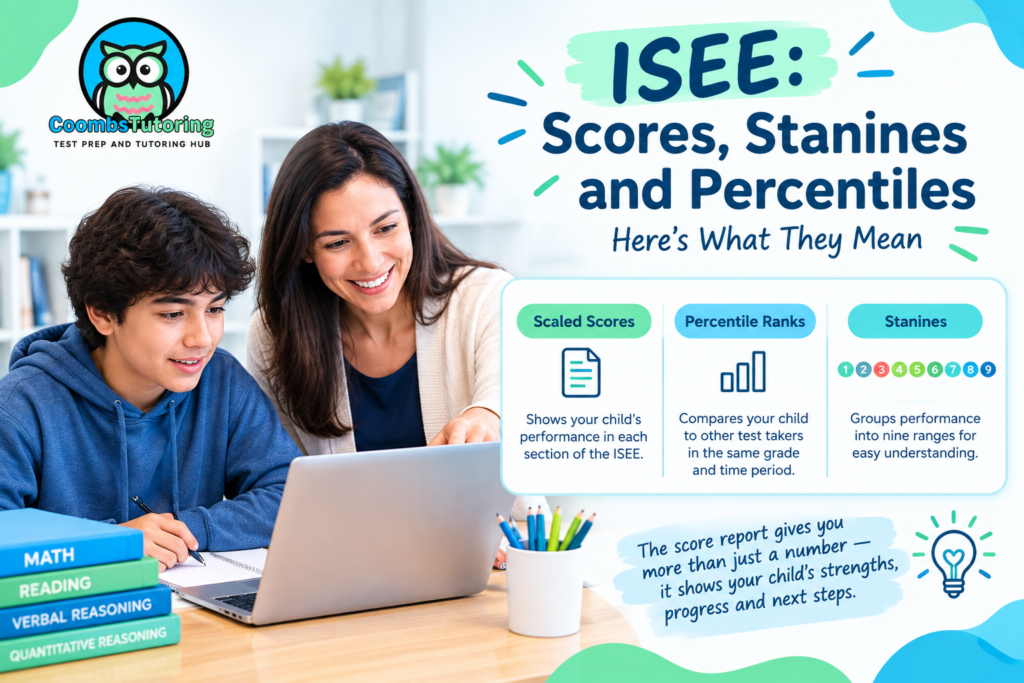
The score report presents performance through scaled scores, percentile ranks, and stanines. These numbers describe performance in different ways, so parents should consider them together rather than concentrating on just one result.
Families who are still learning about the test itself can review the structure, preparation process, and available support through the ISEE test preparation program before deciding what kind of preparation their child may need.
What Is a Good ISEE Score?
There is no universal score that every private school considers good. Admissions expectations can vary from one school to another, and a student’s results should be viewed in the context of the complete application.
One of the easiest ways to understand ISEE performance is through the stanine score. Stanines range from 1 to 9, with 5 representing the midpoint. Higher stanines indicate stronger performance compared with students in the relevant ISEE norm group.
That does not mean every student needs an 8 or 9. A score becomes much more meaningful when parents consider the student’s percentile rank, results in each section, academic record, and the schools to which the student is applying.
Understanding ISEE Stanines and Percentiles
The term stanine comes from “standard nine.” The system groups performance into nine ranges so that families and schools can understand percentile results more easily.
| Stanine | Percentile Range | General Interpretation |
| 9 | 96 to 99 | Exceptionally high |
| 8 | 89 to 95 | Very high |
| 7 | 77 to 88 | Above average |
| 6 | 60 to 76 | Above the midpoint |
| 5 | 40 to 59 | Midpoint range |
| 4 | 23 to 39 | Below the midpoint |
| 3 | 11 to 22 | Below average |
| 2 | 4 to 10 | Low |
| 1 | 1 to 3 | Very low |
These ranges provide useful context, but they should not be treated as an admissions chart. A stanine of 5, for example, places a student around the midpoint of the ISEE norm group. A stanine of 7, 8, or 9 indicates progressively stronger performance within that comparison group, but none of these scores serves as a universal requirement for private school admission.
Percentile rank provides another way to understand the result. If a student receives a percentile rank of 80, it means the student’s performance was equal to or higher than approximately 80 percent of students in the relevant ISEE norm group.
The comparison group is particularly important. ISEE percentiles compare students with other test takers applying to the same grade during the applicable norm period. Because these students are also pursuing independent school admission, parents should not directly compare an ISEE percentile with a percentile from a different school assessment that may use another comparison group.
This explains why a student who performs extremely well in school may receive an ISEE percentile that initially seems lower than expected. The result needs to be understood within the context of the ISEE itself.
Is a Stanine of 5, 6, or 7 a Good Result?
A stanine of 5 corresponds to approximately the 40th through 59th percentile range and represents the midpoint of the stanine scale. It should not automatically be described as either a good or bad result.
A stanine of 6 corresponds to approximately the 60th through 76th percentile range, while a 7 represents approximately the 77th through 88th percentile range. Both indicate performance above the midpoint of the ISEE norm group.
What matters is how the scores fit together. Imagine a student receives a 7 in Reading Comprehension, a 6 in Verbal Reasoning, a 5 in Mathematics Achievement, and a 4 in Quantitative Reasoning. Looking only for an overall label such as “good” or “average” would miss the most useful part of the report. The results suggest that reading is currently a relative strength, while quantitative reasoning may deserve more attention.
This is why parents should look beyond a single number and consider the complete score profile.
What Do Stanines of 8 and 9 Mean?
Stanines of 8 and 9 represent particularly strong performance within the ISEE norm group. A stanine of 8 corresponds to approximately the 89th through 95th percentile range, while a 9 corresponds to approximately the 96th through 99th percentile range.
These are strong results, but they should not be interpreted as guaranteed admission. In the same way, a student who does not receive an 8 or 9 should not automatically be considered a weak applicant.
Private school admission involves more than standardized testing, and there is no single ISEE score that applies to every school.
What Do Private Schools Look for in ISEE Scores?
Parents often want to know whether their child needs a particular stanine to be considered by a competitive school. It is an understandable question, but there is no universal answer.
Private and independent schools can consider ISEE results alongside academic records, teacher recommendations, interviews, essays, writing samples, extracurricular involvement, and other application materials. The importance placed on each part of the application can vary by school.
Instead of asking only, “Is this score high enough?”, it can be more useful to ask, “What does this score tell us about my child’s academic strengths and areas that may need improvement?”
That change in perspective makes the score report much more valuable. It shifts attention away from chasing an arbitrary number and toward understanding the student’s actual performance.
Why Individual Section Scores Matter
Individual ISEE section results can reveal information that an overall impression may hide. A student might perform very well in Reading Comprehension but struggle with Quantitative Reasoning. Another student may understand the mathematics content but have difficulty completing the section within the available time.
Those situations require different approaches. The first student may need additional work with mathematical reasoning concepts, while the second may benefit more from improving pacing, becoming familiar with question types, and learning when to move on from a difficult problem.
This is also why targeted private school entrance exam preparation can be more useful than simply completing large numbers of practice questions. Preparation should respond to what the student’s results actually show.
Why Can Strong Students Receive Unexpected ISEE Scores?
Parents are sometimes surprised when a child who earns excellent grades receives an ISEE percentile that appears modest. This does not necessarily indicate a problem with the student’s academic ability.
The comparison group is one reason. Students taking the ISEE are being compared with other applicants entering the same grade, which can create a competitive testing environment. Classroom performance and standardized testing also place different demands on a student.
A child may understand the academic content but struggle with timing. Another student may spend too much time on difficult questions and have to rush later in the section. Vocabulary, unfamiliar question formats, concentration, and test stamina can also affect performance.
A score should therefore be treated as information about performance on a particular assessment, not as a complete judgment of a student’s academic potential.
What Should Parents Do With an ISEE Score Report?
The most useful approach is to look for patterns. Parents should consider which sections were strongest, where the student experienced difficulty, whether time became an issue, and whether incorrect answers were caused by missing knowledge, misunderstanding questions, or rushing.
This is where a diagnostic assessment can provide valuable direction. Rather than simply producing another number, a thoughtful diagnostic can help identify the skills and testing habits that are influencing performance.
Once those patterns are clear, the preparation plan can become much more specific. Students can spend more time strengthening the areas that need attention while maintaining the skills they already perform confidently.
What If Your Child’s ISEE Score Is Lower Than Expected?
A disappointing result can be frustrating, but it can also provide useful direction. The first step is to understand why points were lost rather than immediately trying to complete more practice questions.
If vocabulary is causing difficulty, preparation can focus on verbal skills. If Quantitative Reasoning is the weaker area, it may be necessary to identify the specific mathematical concepts or reasoning patterns causing problems. If a student understands the material but repeatedly runs out of time, pacing and test strategy may deserve as much attention as academic content.
This is why purposeful practice matters. Students benefit more when they understand why an answer was incorrect and what they should do differently the next time they encounter a similar question.
How Can Students Improve Their ISEE Performance?
Effective preparation begins with identifying the cause of mistakes. A student who answers a mathematics question incorrectly may not understand the concept, may make an error in the calculation, may misread the question, or may rush because time is running short. Each situation requires a different solution.
A structured preparation process can begin with a full diagnostic assessment, followed by a careful review of the results. Instruction can then focus on the areas that genuinely need attention. Regular practice reinforces those skills, while full practice exams help students become more comfortable with timing, question formats, and the concentration required on test day.
At Coombs Test Prep & Tutoring Hub, LLC the ISEE preparation process follows this personalized approach. Diagnostic assessment is used to identify individual needs before instruction is focused on areas such as verbal reasoning, quantitative reasoning, reading comprehension, mathematics achievement, test strategy, and confidence.
For students who need broader academic support in addition to test preparation, online tutoring services can provide personalized instruction based on the student’s academic needs.
Why the ISEE Essay Still Matters
The ISEE essay does not receive a numerical score, but that does not mean students should overlook it. The writing sample is sent to the schools receiving the student’s test results, giving admissions teams an opportunity to see how the student communicates ideas in writing.
Students should practice organizing their thoughts, responding directly to a prompt, and communicating clearly within the available time. The goal is not to memorize an impressive response. A stronger approach is to help students become comfortable expressing their own ideas in an organized and confident way.
How Much ISEE Preparation Does a Student Need?
There is no single preparation schedule that works for every student. Some children already have strong academic foundations and mainly need experience with the test format, question styles, and timing. Others may discover gaps in vocabulary, reading, mathematics, or reasoning that require more focused instruction.
Starting early gives families more flexibility. It provides time to assess current performance, strengthen weaker areas, practice consistently, and measure progress without relying on last minute cramming.
The goal is not to spend as many hours as possible studying. It is to use preparation time where it can be most valuable.
Turning ISEE Results Into a Smarter Preparation Plan
An ISEE score report becomes most valuable when families use it to decide what should happen next. A detailed review can reveal academic strengths, skill gaps, pacing challenges, and areas where more focused practice may be useful.
Instead of reviewing every topic equally, students can concentrate on the concepts and strategies that matter most for their individual performance. Families who would like more structured guidance can explore personalized ISEE preparation to learn more about diagnostic assessment, individualized instruction, practice exams, and support across the different sections of the test.
Final Thoughts
So, what is a good ISEE score? There is no magic number that defines success for every student or guarantees admission to a particular school.
Stanines and percentile ranks provide valuable context, but they are most useful when families understand what those numbers represent and consider them alongside individual section performance and the student’s complete academic profile. A strong result can be encouraging, while a weaker section can be equally useful because it identifies where additional attention may have the greatest value.
The goal should not be to chase a particular number simply because it sounds impressive. A better approach is to understand where the student stands today, identify the skills that deserve attention, and prepare with purpose.
When students understand the test, know what to expect, and have practiced the skills and strategies they need, they can approach the ISEE with greater confidence and a better opportunity to demonstrate what they know.